Folk Customs
—
Han Dynasty (202 BCE–220 CE)
National Heritage
Master-Apprentice
Oral Tradition
Qixi Festival
"China's romantic festival celebrating the once-a-year reunion of star-crossed lovers, with customs of prayer, needlework, and moon-gazing."
CIVILIZATION CONTEXT
This artifact is part of the Intangible Heritage Cluster. It connects to 3 entities across the atlas, spanning 0 regions, 0 masters, 1 festival, and 0 skills.
Qixi Festival: A Living Heritage
The Qixi Festival, known as Chinese Valentine's Day, is celebrated on the 7th day of the 7th lunar month. It commemorates the annual reunion of the Cowherd and Weaver Girl star-crossed lovers separated by the Milky Way. Traditions include praying for skill in needlework, making offerings to the Weaver Girl, and watching for magpies that form a bridge across the heavens. Young women traditionally prayed for sewing skills and a good husband.
0
Related Cultural Vectors
History & Development
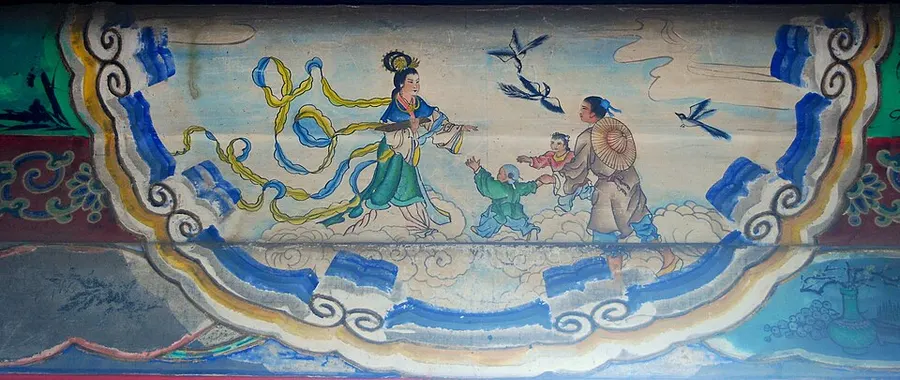
The heart of Qixi is not the date but the story it encodes: a heavenly weaver married an earthly cowherd, and the Queen Mother of the West punished the match by splitting them into two stars that meet only once a year across a bridge built by magpies. Read as folklore it is a love story, but read as Chinese cosmology it is a story about separation, filial obligation, and the small mercy of one reunion a year. The Weaver Girl, Zhuinu, is remembered as a weaver of extraordinary skill, and the night takes its old name Qiqiao, the Festival of Skill, because women asked her for dexterity rather than romance.
That emphasis on making is what the heritage listing protects. Qixi entered the first national intangible cultural heritage batch in May 2006, not because of the romance industry that now surrounds it, but because the needle contests, the qiqiao handiwork displays, and the qiaoguo pastry shaping encode a body of women's craft knowledge that was being handed down mainly through household practice. Modern cities market Qixi as Chinese Valentine's Day, but the older layer survives in temple fairs where women still compete at threading seven-holed needles by starlight, keeping the skill the star was originally asked to sharpen.
Symbols of Qixi and What They Mean
- 01
Threading under the moon
Women race to pass silk through seven-holed needles by starlight alone, a ritual that frames eyesight and steady hand as gifts to be improved, which is why the contest is a petition for skill rather than a sport.
- 02
Floating the needle
A fine needle set on the next morning's water forms shadow patterns read as signs of a neat or clumsy hand, turning a household game of divination into a quiet self-assessment of a girl's readiness for adult work.
- 03
Frying qiaoguo
Families shape fried dough into spirals and slender hands and oil them golden, a craft passed mother to daughter so the skill of the season is carried forward rather than lost between households.
- 04
Displaying handiwork
Embroideries and knotted cords go on the courtyard table overnight so the star may inspect the maker's work, treating the Weaver Girl as an implicit teacher whose approval is the point of the display.
Common Questions
What does the Weaver Girl story symbolize?
A heavenly weaver married an earthly cowherd, and the queen mother split them into stars joined once yearly by a magpie bridge, a tale about punished separation and hard-won reunion expanded in the cowherd and weaver girl story.
Is Qixi only about romance?
Historically it celebrated women's craftsmanship above romance, honouring the needle skills still showcased by Suzhou embroidery masters, with courtship a later layer added by modern celebration.
Why does Qixi matter for traditional women's crafts?
Because the festival was a skill ritual: the qiqiao handiwork displays and needle contests were a way of asking the Weaver Girl for better hands, and Qixi entered the national heritage list in 2006 to protect exactly that craft knowledge.
Why was Qixi included in the national heritage list in 2006?
The listing protects the craft layer of the festival, the needle contests, handiwork displays, and qiaoguo shaping that were being handed down only through household practice, rather than the modern Valentine's Day marketing built on top of the star story.
Watch & Learn
Stories & Legends
The Cowherd and the Weaver Girl
mythA young cowherd named Niulang discovers the heavenly weaver girl Zhinu bathing in a river. They fall in love and marry, but Zhinu's mother, the Queen Mother of Heaven, separates them with the Milky Way. Once a year, on the seventh night of the seventh month, magpies form a bridge across the stars so they can reunite — this is the origin of Qixi Festival.
Want to know when & how it's celebrated?
View the festival guide & datesRelated Festivals
Relationship Constellation
Tracing the invisible threads that connect Qixi Festival to the broader civilization ecosystem.
Continue the Journey
Qixi Festival
Folk Customs
Lantern Festival
Folk Customs
arrow_forwardChinese Herbal Medicine
Traditional Medicine
arrow_forwardChinese Tea Ceremony
Folk Customs
arrow_forward