Traditional Drama
Suzhou, East China
Ming dynasty (14th–17th century CE)
Representative List
Master-Apprentice (Oral/Aural)
Oral Tradition
Kunqu Opera
"One of China's oldest opera forms, known for its exquisite poetry, elegant movements, and profound influence on all Chinese theater."
CIVILIZATION CONTEXT
This artifact is part of the Intangible Heritage Cluster. It connects to 16 entities across the atlas, spanning 3 regions, 1 master, 0 festivals, and 0 skills.
Kunqu Opera: A Living Heritage
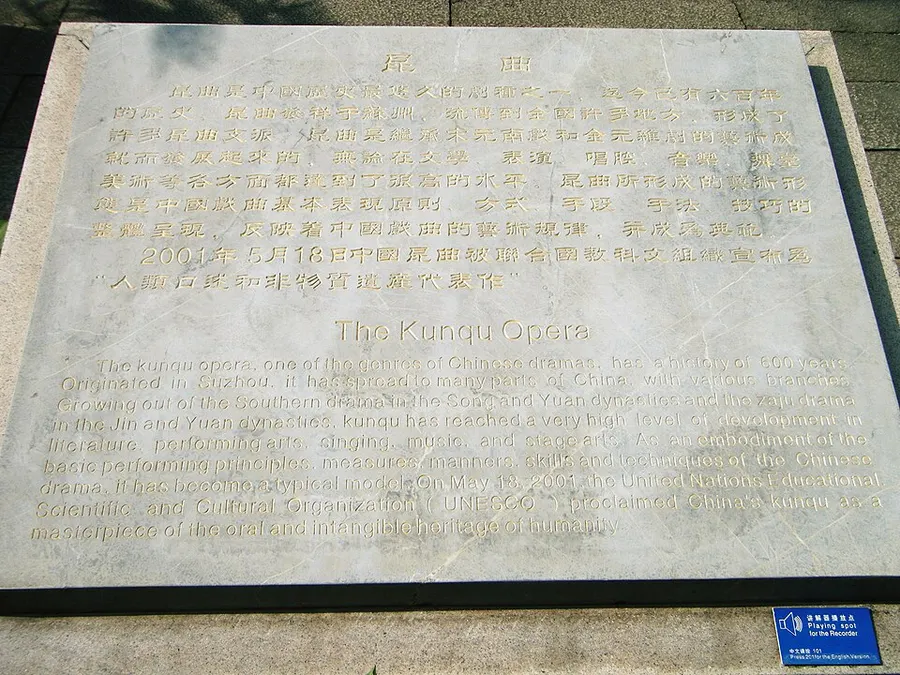
Kunqu is one of the oldest forms of Chinese opera, originating in the Kunshan region of Suzhou during the Ming Dynasty. Known for its refined singing, graceful movements, and poetic librettos, Kunqu has profoundly influenced other Chinese opera forms including Peking Opera. Its repertoire includes timeless classics like "The Peony Pavilion" and "The Palace of Eternal Life."
0
Related Cultural Vectors
Sources & Evidence
Status UNESCO Representative List (inscribed)
Primary source UNESCO Intangible Cultural Heritage, Representative List — Nomination file No. 00004: https://ich.unesco.org/en/RL/kunqu-opera-00004
- — Inscribed on the UNESCO Representative List in 2008 (originally proclaimed a Masterpiece in 2001). (Nomination file 00004; 3.COM)
- — Developed under the Ming dynasty (14th–17th centuries) in Kunshan, in the Suzhou region of southeast China. (UNESCO ICH element description, file 00004)
- — Its classic repertoire includes The Peony Pavilion and The Hall of Longevity. (UNESCO ICH element description, file 00004)
Last reviewed: 2026-10-13
Status and primary source follow the official record. Other narrative on this page — including cultural interpretation — is the Atlas's own reading, not an external source.
History & Development
Kunqu grew out of Kunshan singing styles that Wei Liangfu refined into the water-mill voice during the 1550s, smoothing every syllable into gliding ornamentation. Tang Xianzu completed The Peony Pavilion in 1598, and its fifty-five scenes became the genre's signature play as troupes spread through Jiangnan gardens and Beijing courts alike.
Competition from Peking opera nearly emptied Kunqu stages by the early twentieth century until the Kunju School preserved several hundred plays in the 1920s. UNESCO named Kunqu one of the first Masterpieces of Oral and Intangible Heritage in 2001, moving it to the Representative List in 2008.
How It Is Made
- 01
Shaping the qupai melody
Singers fit text to labelled melodic templates, bending each syllable through prescribed turns while a dizi flute doubles the line.
- 02
Refining pronunciation
Lyrics follow Suzhou-stage diction where initials, finals, and tones differ from everyday Mandarin, keeping rhymes intelligible across regions.
- 03
Speaking through sleeves
Long water sleeves extend gesture language: flicks dismiss, coils hesitate, and throws signal despair, all timed to drum cues.
- 04
Staging minimal scenery
A bare stage plus one table and two chairs stand for mountains, boats, or courts as narration and movement define each place.
Common Questions
What does water-mill voice mean?
Wei Liangfu compared the polished, slowly turning melisma to grain ground between millstones. A single character can stretch over a dozen beats as ornament wraps the vowel.
How long is a full performance?
Traditional cycles ran several evenings. Bai Xianyong's Youth Edition Peony Pavilion condenses the play into three three-hour evenings and tours campuses worldwide.
Is the language hard to follow?
Surtitles in Chinese and English now accompany most productions, and audiences rely on them just as opera houses do for Italian repertoire.
Watch & Learn
Stories & Legends
The Peony Pavilion
mythWritten by Tang Xianzu in 1598, "The Peony Pavilion" is the most famous Kunqu Opera. It tells the story of Du Liniang, a young woman who dreams of a scholar named Liu Mengmei and dies of lovesickness. She later returns as a ghost to pursue her love. The play explores themes of love, dreams, and the triumph of emotion over death.
Why Kunqu Was Born in Jiangnan
historicalIn the late Ming Dynasty, a new sound emerged from the gardens of Suzhou — delicate, refined, and achingly beautiful.
The Art of Silence: Peking Opera's Journey from Court to World
historicalIn a Peking Opera performance, every gesture tells a story.
The Sound of Silk: Guzheng Across Millennia
historicalWhen the guzheng player's fingers sweep across 21 strings, Chinese memory speaks.
Generations Preserved
Zhang Jun
Zhang Jun is a contemporary Kunqu Opera master and one of its most innovative ambassadors. A student of the legendary Kunqu artist Cai Zhengren, Zhang has performed leading roles in classics like "The...
Relationship Constellation
Tracing the invisible threads that connect Kunqu Opera to the broader civilization ecosystem.