menu_book The Full Narrative
01
Tang Xianzu's Masterpiece
Tang Xianzu, the Ming Dynasty's greatest dramatist, composed The Peony Pavilion in 1598, at the height of his career in Jiangnan. The play runs to fifty-five scenes, its poetry unmatched in Chinese drama. The celebrated aria "The Interrupted Dream" — depicting Du Liniang's garden walk and dream of love — is considered the soul of Kunqu.
02
Love, Dream, and Return
Du Liniang, forbidden by her father from visiting the garden, dreams of a scholar with a willow branch, Liu Mengmei. She dies of lovesickness, but her portrait and her ghost pursue the dream to life; in the play's second half, love itself reunites the lovers beyond death. This philosophy of qing — passion as the force that conquers all — made the play revolutionary for its time.
03
The Stage of Jiangnan
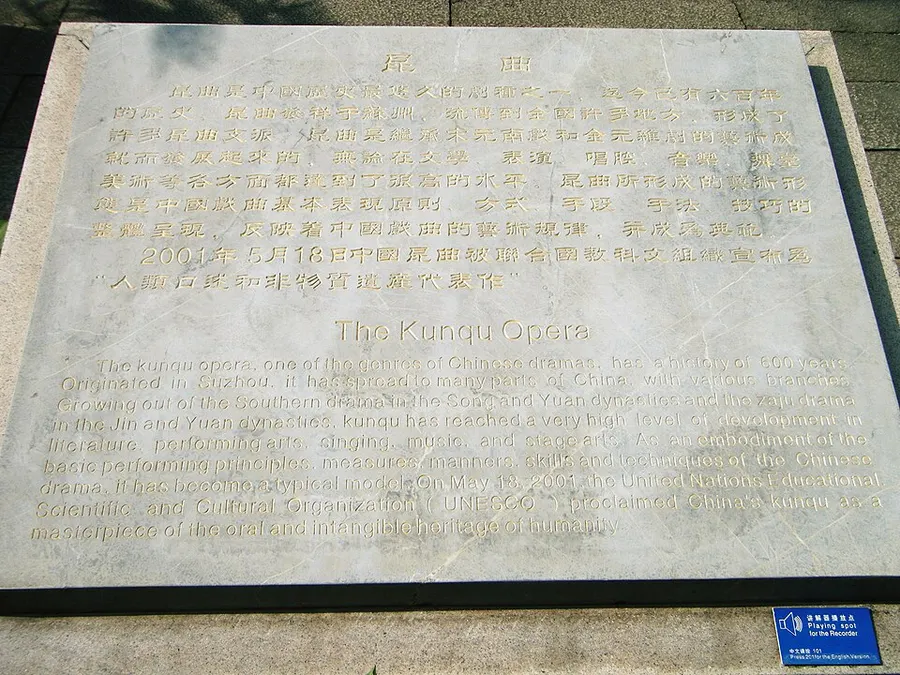
Kunqu was born in the gardens of Suzhou and the canal towns of Jiangnan, where water, architecture, and music fused into a refined aesthetic. The Peony Pavilion, performed in private garden theaters, became the form's defining work — and when UNESCO inscribed Kunqu as a Masterpiece of the Oral and Intangible Heritage of Humanity in 2001, it was The Peony Pavilion that carried the tradition onto the world stage.
04
Arias Passed From Mouth to Mouth
For two centuries after 1598, households learned the play through handwritten scores and oral instruction rather than printed editions. Singers memorized roughly 200 arias to master the full role system, yet a single evening's performance used only a dozen. The Kunshan water-mill singing style dictates every ornament, stretching one syllable across several beats while the flute traces a counter-line. Teachers still correct breath placement first and words second, because the melody lives in the vowel.
05
The Youth Edition That Rebuilt an Audience
By the 1990s Kunqu troupes averaged fewer than a dozen new productions a decade, and theaters emptied. In 2004 producer Kenneth Pai launched a Youth Edition of The Peony Pavilion with the Suzhou Kunqu Opera Theatre, recasting the lovers with performers under thirty and touring it to more than a hundred university campuses worldwide. Young audiences returned in numbers unseen for generations, and graduates of those tours now lead the company's roster. The revival also renewed interest in individual artists such as Zhang Jun's scholar-lover roles, which brought Kunqu into concert halls and riverside gardens alike.
06
The Garden Becomes the Stage
The Peony Pavilion found a purpose-built home in 2010 when composer Tan Dun staged a garden edition at Zhujiajiao's Kezhi Garden in Shanghai. Audiences drift through courtyards as scenes unfold on separate pavilions, boats ferrying viewers between acts across the pond, restoring the intimacy that Ming-era garden performances assumed. Tickets sell as season subscriptions rather than single evenings, and the production runs weekends most of the year with rotating casts from provincial companies. Other cities copied the format: Suzhou's Master-of-Nets Garden hosts condensed nightly versions where the hall's dimensions cap audiences below a hundred, pricing intimacy into heritage. Critics credit garden staging with solving Kunqu's acoustics problem, since unamplified water-polished voices need reflective stone, not auditorium carpeting. The format also created employment for young performers who once waited years for principal roles, giving the 400-year-old opera a career ladder matched to tourism economics rather than state subsidy alone.