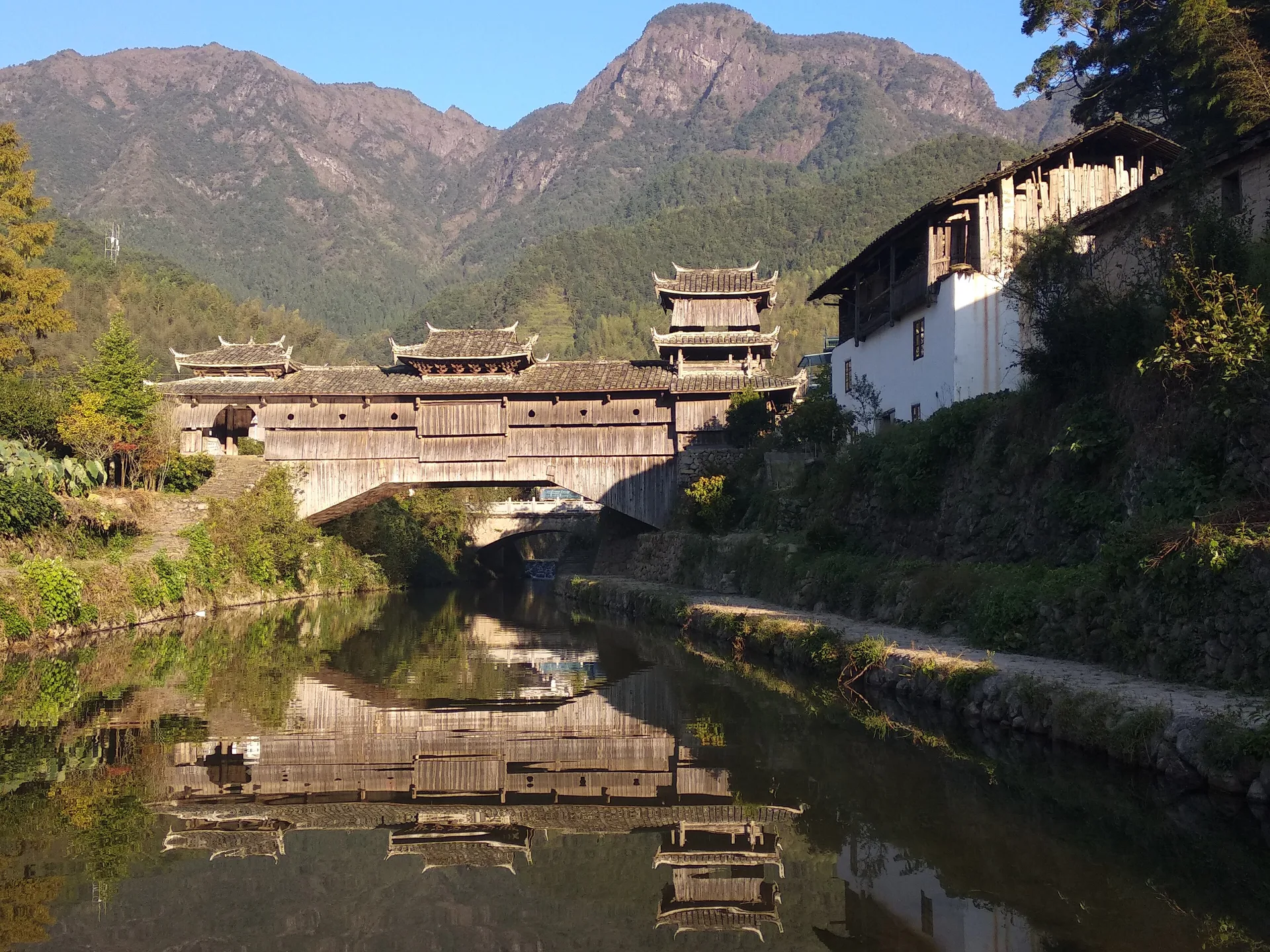
 Photo: Devils-卫卿 / Wikimedia Commons / CC BY-SA 4.0
 Traditional Crafts
Fujian Province, Southeast China
Song Dynasty (960–1279 CE)
Representative List
Master-Apprentice (Hands-on)
Mortise-and-Tenon Joinery
Wooden Arch Bridge Construction
"Self-supporting wooden bridges built without nails using interlocking beams — a masterpiece of Chinese structural engineering."
CIVILIZATION CONTEXT
This artifact is part of the Intangible Heritage Cluster. It connects to 7 entities across the atlas, spanning 1 region, 1 master, 0 festivals, and 1 skill.
Wooden Arch Bridge Construction: A Living Heritage
The traditional craft of building wooden arch bridges in Fujian and Zhejiang provinces uses interlocking timber beams with mortise-and-tenon joints — no metal nails or adhesives. These self-supporting bridges span mountain streams and support roofed pavilions that serve as community gathering spaces. The technique represents an extraordinary understanding of structural mechanics and ecological adaptation.
1
Related Cultural Vectors
Sources & Evidence
Status UNESCO Representative List (inscribed)
Primary source UNESCO Intangible Cultural Heritage, Representative List — Nomination file No. 02156 (transferred from 00303, inscribed 2009 on the Urgent Safeguarding List, transferred 2024): https://ich.unesco.org/en/RL/traditional-design-and-practices-for-building-chinese-wooden-arch-bridges-02156
- — Inscribed on the List of Intangible Cultural Heritage in Need of Urgent Safeguarding in 2009 (Decision 4.COM 14.03) and transferred to the Representative List in 2024 (Decision 19.COM 7.c.3). (Nomination file No. 02156; 19.COM decision 7.c.3)
- — Wooden arch bridges are found in Fujian and Zhejiang provinces along China's southeast coast; building them combines wood, traditional architectural tools and craftsmanship, the core technologies of 'beam-weaving' and mortise and tenon joints, and an experienced woodworker's understanding of different environments and the necessary structural mechanics. (UNESCO ICH element description, file 02156)
- — The element was first inscribed on the Urgent Safeguarding List because the tradition had declined over the years due to rapid urbanization, scarcity of timber and lack of available construction space, which together threatened its transmission and survival. (UNESCO ICH element description, file 02156)
Last reviewed: 2026-10-13
Status and primary source follow the official record. Other narrative on this page — including cultural interpretation — is the Atlas's own reading, not an external source.
History & Development
The wooden arch bridges of China's southeast are "woven" structures of interlocking straight logs that depend on gravity, holding their shape under the dead weight of the roofed corridor that caps them — which is also why water and wind, which can lift a span, are the real hazard. Carpenters in Fujian and neighbouring Zhejiang span rivers up to forty metres with three rows of longitudinal beams laced through five rows of transverse ones. The structure was long known only from the field: it was scholars in the 1980s, including Mao Yisheng and Tang Huancheng, who described it and compared these bridges to the soaring bridge in Zhang Zeduan's Song scroll "Along the River During Qingming" — the painting did not record the type. Mountain counties kept building them for market days, temple fairs, and shelter from storms well into the twentieth century.
The lineage narrowed to a handful of master families, which is precisely why documentation matters. The technique entered UNESCO's List of Intangible Cultural Heritage in Need of Urgent Safeguarding in 2009 and was transferred to the Representative List in 2024. Zheng Duojin, a national-level inheritor from Shouning in Fujian, has led reconstructions of historic spans. Around a hundred historic bridges survive, concentrated in the counties named in the UNESCO nomination — Pingnan, Shouning and Zhouning in Fujian, and Qingyuan and Taishun in Zhejiang — because a bridge there still counts as a communal hall with a roof.
How It Is Made
- 01
Selecting the span
Carpenters read river width, flood marks, and rock abutments, then scale the weave so beam length never exceeds what a hillside cedar yields.
- 02
Weaving the arch
Longitudinal beams are threaded through transverse "scissors" beams alternately from both banks until the arch locks itself by compression.
- 03
Raising the frame
The finished arch is levered upright with ropes and counterweights in a single ceremony watched by the whole village.
- 04
Roofing the corridor
A tiled timber corridor caps the arch, its benches and shrines turning infrastructure into social space.
Common Questions
Do the bridges use nails?
The craft relies on interlocking timber and mortise-and-tenon joinery rather than ironwork. The structure depends on gravity and on the dead weight of the roofed corridor for stability, so the real hazard is uplift from water and wind rather than flood shear, as discussed in our timber architecture entry.
How long can they last?
Several historic spans have stood for three centuries or more — the Xianju Bridge, built in 1673, is among the oldest — with re-roofing every few decades; the arch itself survives as long as joints stay dry and traffic stays light.
Where are they concentrated?
The surviving cluster lies in the counties named in the UNESCO nomination — Pingnan, Shouning and Zhouning in Fujian, and Qingyuan and Taishun in Zhejiang.
Watch & Learn
Skills & Techniques
Mortise-and-Tenon Joinery expand_more
A traditional Chinese woodworking technique that connects wooden components without nails or glue, using precisely carved interlocking joints.
Steps
- Select and season high-quality timber (traditionally Chinese fir)
- Measure and mark the joinery points
- Cut the mortise (socket) using chisels
- Shape the tenon (projecting piece) to match precisely
- Test-fit and adjust until the joint is tight
- Assemble without glue — friction and compression hold the joint
Tools
axe, chisel set, ink marker (modou), hand saw, plane, mallet
Materials
Chinese fir (Cunninghamia lanceolata), cedar, pine
Related Places
Generations Preserved
Zheng Duojin
Zheng Duojin is a 6th-generation master of wooden arch bridge construction in Fujian Province. Born into a family of bridge builders, he began learning the craft at age 16 from his father. Over six de...
Relationship Constellation
Tracing the invisible threads that connect Wooden Arch Bridge Construction to the broader civilization ecosystem.
Continue the Journey
Wooden Arch Bridge Construction
Traditional Crafts
Acupuncture and Moxibustion
Traditional Medicine
arrow_forwardPeking Opera
Traditional Drama
arrow_forwardNanjing Yunjin Brocade
Traditional Crafts
arrow_forward