Traditional Drama
Beijing, North China
Qing Dynasty, late 18th century CE
Representative List
Master-Apprentice (Oral/Aural)
Oral Tradition
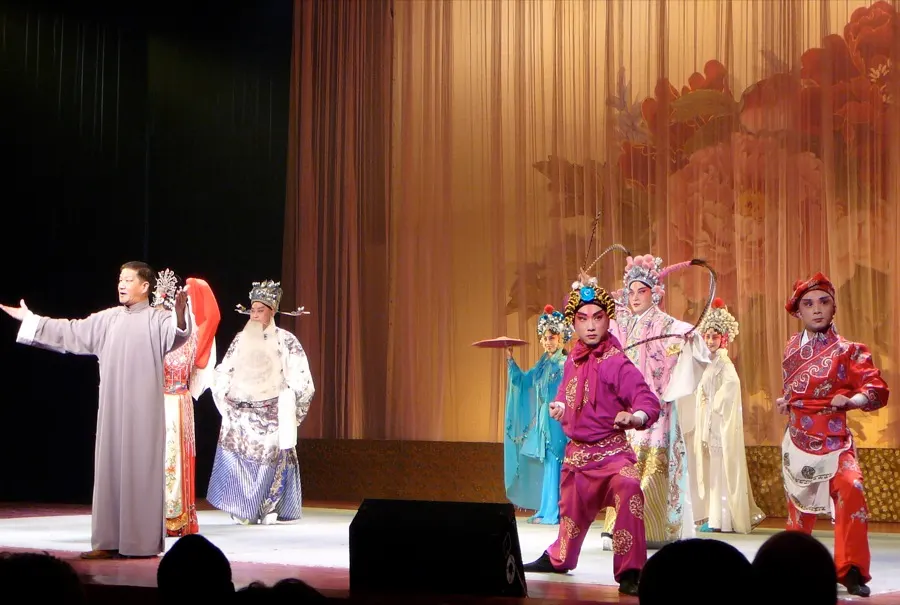
Peking Opera
"China's most celebrated opera form, blending music, dance, acrobatics, and elaborate costumed performance into a spectacular theatrical art."
CIVILIZATION CONTEXT
This artifact is part of the Intangible Heritage Cluster. It connects to 12 entities across the atlas, spanning 1 region, 2 masters, 0 festivals, and 0 skills.
Peking Opera: A Living Heritage
Peking Opera is a comprehensive performing art that combines music, vocal performance, mime, dance and acrobatics. Formed in Beijing during the late 18th century, it features four main role types — sheng (male), dan (female), jing (painted face), and chou (clown). Known for its elaborate costumes, symbolic makeup, and stylized movements, Peking Opera is considered the quintessence of Chinese culture.
0
Related Cultural Vectors
History & Development
Peking opera formed when Anhui troupe masters brought their repertoires to Beijing for imperial birthday celebrations in 1790 and absorbed Hubei melodies, Kunqu arias, and northern percussion over the following decades. By the mid-nineteenth century the blend had hardened into a distinct genre centred on Beijing stages such as the Guanghe theatre.
Mei Lanfang carried the genre to Japan in 1919 and to America in 1930, where universities granted him honorary doctorates. UNESCO inscribed Peking opera on the Representative List in 2010, and state academies now graduate performers trained from childhood in the four role families of sheng, dan, jing, and chou.
How It Is Made
- 01
Training the four skills
Students drill song, speech, dance-acting, and combat daily from ages nine or ten, repeating basics for years before touching full plays.
- 02
Mastering a role type
Each performer specialises in one role family, learning its walk, gesture vocabulary, and repertoire conventions passed teacher to disciple.
- 03
Painting the face
Jing heroes wear colour-coded masks painted directly on skin: red for loyalty, white for treachery, black for blunt integrity.
- 04
Playing with the orchestra
A jinghu fiddle leads melody while gongs, cymbals, and a hardwood clapper punctuate entrances, exits, and fight sequences beat by beat.
Common Questions
Why does the singing sound so high?
Dan and sheng parts sit in registers chosen to carry over outdoor percussion without amplification, using falsetto placement and bright vowels developed for open-air stages.
Where can newcomers watch a performance?
Beijing's Huguang Guild Hall and Liyuan Theatre stage subtitled highlights several nights a week, and provincial companies tour internationally after major festivals.
How is it different from Kunqu?
Kunqu sings long water-polished melodies to a flute and predates Peking opera by more than two centuries, while Peking opera favours percussive drama and spoken delivery. Both share repertoire sources, and Zhang Jun's Kunqu productions often appear on the same festival programmes today.
Watch & Learn
Stories & Legends
The Art of Silence: Peking Opera's Journey from Court to World
historicalIn a Peking Opera performance, every gesture tells a story.
Shadow Puppetry: Light, Leather, and Legend
historicalThe world's first animated cinema, centuries before film.
Silk: The Thread That Connected Civilizations
historicalThe humble silkworm created the world's first global trade network.
Related Places
Generations Preserved
Mei Lanfang
Mei Lanfang was the most famous Peking Opera performer of the 20th century, renowned for his female lead (dan) roles. He revolutionized Peking Opera by combining traditional techniques with innovative...
Mei Baojiu
Mei Baojiu was the son of Mei Lanfang and the primary heir of the Mei School of Peking Opera. Born into the Mei family, he dedicated his life to preserving and transmitting his father's artistic legac...
Relationship Constellation
Tracing the invisible threads that connect Peking Opera to the broader civilization ecosystem.