Traditional Sports
Chenjiagou, Central China
Chenjiagou, 17th century CE
Representative List
Master-Apprentice
Oral Tradition
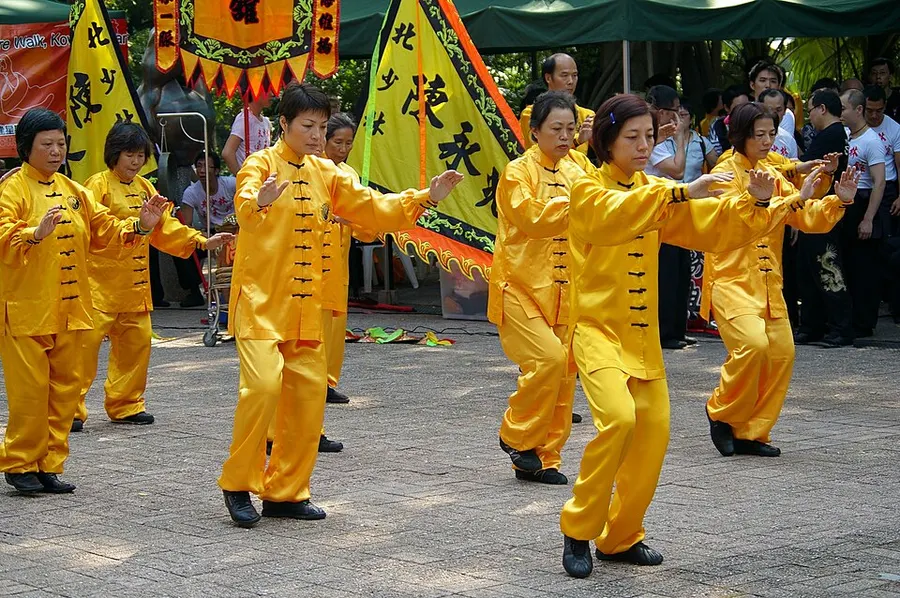
Taijiquan (Tai Chi)
"A graceful martial art blending slow movement, meditation, and philosophy. Practiced worldwide for health and spiritual cultivation."
CIVILIZATION CONTEXT
CROSS-SITE REFERENCES
TheWayOfNatureAtlas
Body System: Embodied Movement
Taijiquan as the core practice of the body system — finding strength in softness
taleswithlee
The Philosophy of Yin and Yang in Tai Chi
Deep dive into the Daoist philosophy that gives Taijiquan its spiritual foundation
TheWayOfNatureAtlas
Tai Chi (太极拳): The Entity View
The same lineage held as a living entity in a natural-philosophy system, not only as an inscribed national sport
This artifact is part of the Intangible Heritage Cluster. It connects to 13 entities across the atlas, spanning 1 region, 1 master, 0 festivals, and 0 skills.
Taijiquan (Tai Chi): A Living Heritage
Taijiquan, known in the West as Tai Chi, is a traditional Chinese martial art that combines slow, graceful movements with deep breathing and mental focus. Originating in Chenjiagou village, it has evolved into multiple styles including Chen, Yang, Wu, and Sun. Practiced worldwide for its health benefits, Taijiquan embodies the Taoist philosophy of yin and yang — finding strength in softness.
0
Related Cultural Vectors
Sources & Evidence
Status UNESCO Representative List (inscribed)
Primary source UNESCO Intangible Cultural Heritage, Representative List — Nomination file No. 00424: https://ich.unesco.org/en/RL/taijiquan-00424
- — Inscribed on the UNESCO Representative List in 2020. (Nomination file 00424; 15.COM 8.b.21)
- — A traditional physical practice of relaxed, circular movements combined with breath regulation and the cultivation of a righteous, neutral mind. (UNESCO ICH element description, file 00424)
- — It emerged in the mid-17th century in Chenjiagou, Wen County, Henan Province. (UNESCO ICH element description, file 00424)
Last reviewed: 2026-10-13
Status and primary source follow the official record. Other narrative on this page — including cultural interpretation — is the Atlas's own reading, not an external source.
History & Development
Taijiquan took shape in the village of Chenjiagou, Henan province, where ninth-generation villager Chen Wangting organised existing martial routines into paired silk-reeling exercises during the seventeenth century. The Chen family kept the system within the clan until Yang Luchan learned it in the 1820s and carried it to Beijing, where he began teaching openly and founded the most widely practised branch.
From those Beijing classrooms came four further major styles named after the Wu, Wu (Hao), Sun families and the original Chen lineage. The Chinese government standardised simplified 24-form routines in 1956 for mass education, and by the 2020s researchers estimated more than 100 million people worldwide practise some form. UNESCO inscribed taijiquan on the Representative List in December 2020.
How It Is Made
- 01
Standing meditation
Practice begins with zhan zhuang, holding relaxed postures for minutes at a time until weight sinks evenly through both feet.
- 02
Silk-reeling spirals
Students drill chan si gong, rotating waist and limbs around a steady axis so force winds and unwinds like thread off a cocoon.
- 03
Form sequences
Long hand forms link dozens of postures in continuous slow motion; beginners often start with the 24-form set before family lineages add longer versions.
- 04
Push-hands exchange
Two practitioners maintain contact through wrists and forearms, learning to read and redirect an opponent's centre without brute strength.
Common Questions
Is tai chi a martial art or exercise?
It is both. The slow forms train balance and breathing, while push-hands drills preserve the self-defence applications of every posture. Competition divisions now cover forms, weapons, and controlled sparring.
Which style should a newcomer choose?
Most teachers recommend the standardised 24-form Yang routine because manuals and classes are widely available. Students seeking deeper martial content often continue to Chen-style training in Chenjiagou or its city branches.
What does daily practice actually change?
Clinical reviews associate regular practice with better balance, lower fall risk in older adults, and reduced joint pain. Practitioners typically notice steadier stance and calmer breathing within three months of consistent sessions.
Watch & Learn
Stories & Legends
Tai Chi: From Martial Art to Global Meditation
historicalA fighting technique from a remote village became a global phenomenon.
The Dragon Boat Festival: Memory, River, Nation
historicalA poet's sacrifice became a nation's memory, celebrated every summer.
Related Places
Generations Preserved
Chen Wangting
Chen Wangting was a 17th-century Ming Dynasty military officer from Chenjiagou, Henan Province, credited as the founder of Taijiquan. Drawing from his martial arts training, Taoist philosophy, and tra...
Relationship Constellation
Tracing the invisible threads that connect Taijiquan (Tai Chi) to the broader civilization ecosystem.
Continue the Journey
Taijiquan (Tai Chi)
Traditional Sports
Kunqu Opera
Traditional Drama
arrow_forwardNanjing Yunjin Brocade
Traditional Crafts
arrow_forwardGuqin and Its Music
Traditional Music
arrow_forward