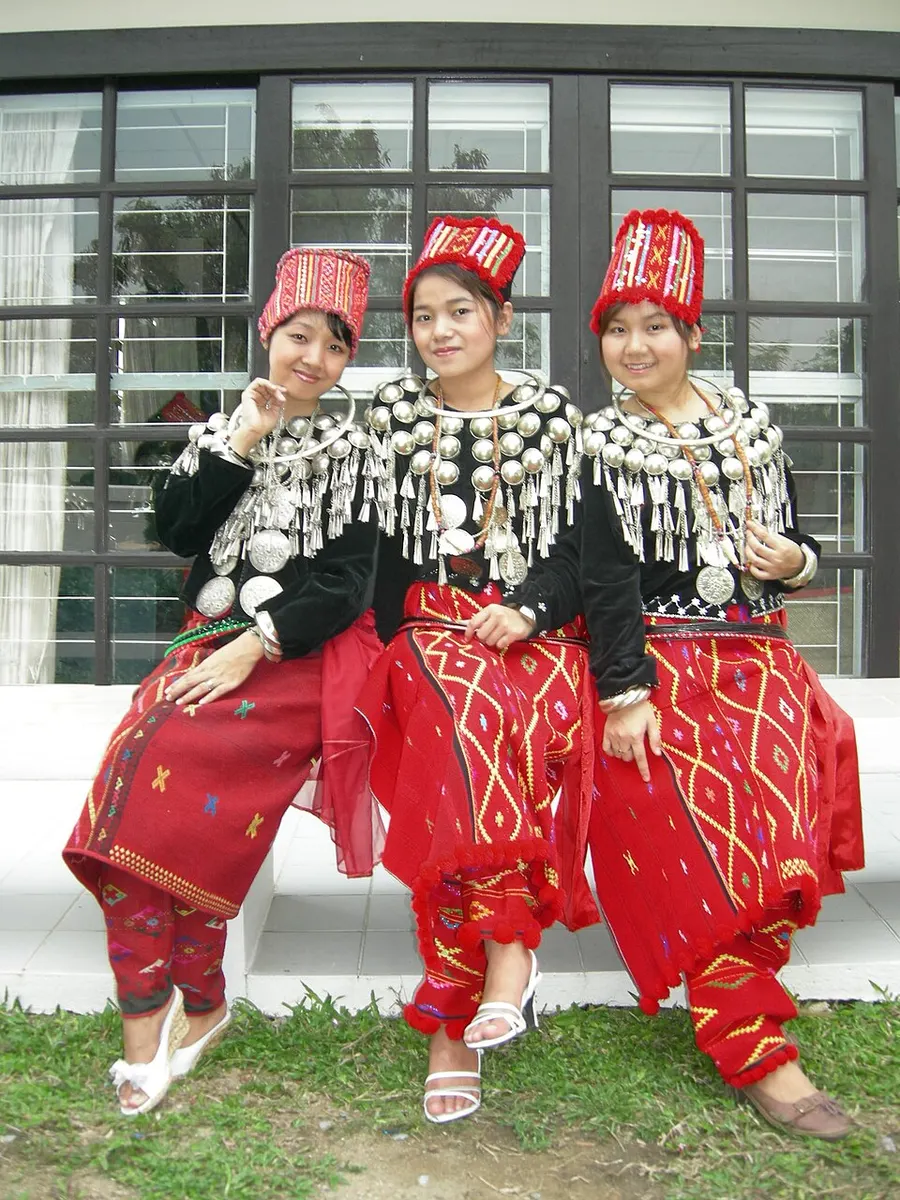
Jingpo (Kachin) (景颇族)
Cross-border people of western Yunnan and Myanmar's Kachin State, known for the Munao Zongge festival and sword dance traditions; their home prefecture is Dehong Dai and Jingpo Autonomous Prefecture.
The Soul of the Jingpo (Kachin)
Cross-border people of western Yunnan and Myanmar's Kachin State, known for the Munao Zongge festival and sword dance traditions; their home prefecture is Dehong Dai and Jingpo Autonomous Prefecture.
Cultural DNA
- Identity
- Jingpo (Kachin)
- 景颇族
- Population
- 160,471
- 0.01% of China
- Language Family
- Jingpho (Tibeto-Burman)
- Primary Regions
- Yunnan
- Status
- Active · Living Tradition
Living Traditions
Intangible knowledge passed through generations.
Neighboring Peoples
The Jingpo (Kachin) share cultural landscapes and historical exchange with neighboring ethnic communities across the region.
The Ritual Cycle
Festivals mark the rhythms of life for the Jingpo (Kachin) — celebrating harvests, honoring ancestors, and strengthening community bonds through music, dance, and feasting.
No festival relations recorded. Explore festival calendar
Cross-Cultural Threads
History & Development
The Jingpo, about 160,000 people at China's 2020 census, are one of the country's 56 officially recognised ethnic groups, living mainly in Dehong Dai and Jingpo Autonomous Prefecture — a stretch of western Yunnan that borders Myanmar's Kachin State, where their kin form the largest subgroup of the Kachin peoples. Their social fabric sorts lineages into chiefly and commoner houses governed by elders' councils, and their great collective rite — Munao Zongge — gathers tens of thousands into synchronized procession around carved pillar-boards depicting sun, mountain, and migration paths.
Munao festivals were once royal ceremonies of the Jingpo aristocracy; in 1983 the Dehong prefecture people's congress made Munao Zongge a legal prefecture festival, fixed to the fifteenth and sixteenth days of the first lunar month, and in 2006 it entered China's first national list of intangible cultural heritage, declared by Longchuan county in Yunnan. The dance is held on both sides of the border. Women's tubular skirts blaze with woven sun-ray patterns that Jingpo tradition traces to descent from a sun-born ancestor, while hospitality feasts serve rice in folded leaves — the "green leaf banquet" that codes generosity into edible form.
The Jingpo language, Jingpho, belongs to the Tibeto-Burman family and is written in a Latin-based alphabet introduced by American Baptist missionaries in the late nineteenth century and later reformed; China has used an improved Latin orthography since 1957. It has no traditional script of its own — before the alphabet, records were kept by notching wood or tying knots. In China "Jingpo" is an umbrella name for five related groups, of which Jingpo proper belongs to the Jingpo branch while Zaiwa, Leqi, Lang'e and Bola are Burmish languages closer to Burmese and Achang. The Jingpho creation epic Manau Jaiwa was added to the national list in 2011.
Cultural Pillars
- 01
Munao Zongge Mass Dance
Two lead priestesses ("na shuang") trace labyrinthine column routes with sash and sword, thousands following in step for hours — choreography said to reenact ancestral return journeys.
- 02
Sun-Ray Skirt Weaving
Backstrap looms weave diamond fields radiating from skirt hems, pattern language asserting noble descent from the sun-born ancestor.
- 03
Green Leaf Banquet
Guests receive rice, game, and wild herbs bundled in fresh leaves — portable feasting etiquette for hunters that now crowns festival hospitality tables.
- 04
Munao Pillar Carving
Four painted columns — sun, moon, breast, and knife motifs — anchor the dance ground, their iconography readable as a compact map of cosmos and clan law.
- 05
Jingpho Writing
The Jingpo write their language, Jingpho, in a Latin-based alphabet used in China since 1957; it replaced no earlier script, since records had been kept by notching wood or tying knots. Four further Burmish-speaking groups are classified under the same official ethnic name.
Common Questions
When is Munao Zongge held?
The prefecture festival falls on the fifteenth and sixteenth days of the first lunar month, a date fixed when Dehong made it a legal prefecture festival in 1983; Luxi stages the largest official edition with tens of thousands dancing, while village editions run on their own auspicious days through the season.
Can outsiders join the dance?
Yes — visitors follow the spiral columns behind lineage blocks; the two lead dancers keep order so newcomers simply mirror neighbors, making it among the world's most accessible mass choreographies.
What does the pillar imagery mean?
Sun and moon mark origin ancestry, the double-breast panel honors nourishment across clans, and crossed knives assert protection — together a public covenant renewed each festival in western Yunnan.
What language do the Jingpo speak?
The Jingpo speak Jingpho, a Tibeto-Burman language written in a Latin-based alphabet and possessing no traditional script of its own. In China the official ethnic name also covers four related Burmish-speaking groups — Zaiwa, Leqi, Lang'e and Bola.