menu_book The Full Narrative
01
The Jiangnan Aesthetic
Jiangnan has always been defined by water — canals winding through whitewashed towns, mist rising from Taihu Lake, gardens designed as miniature landscapes. This environment cultivated a refined aesthetic that valued subtlety over spectacle. Kunqu's slow, graceful movements and its emphasis on lyrical expression mirror the Jiangnan sensibility perfectly.
02
The Garden Stage
Kunqu was not performed in grand imperial theaters but in private gardens, on delicate stages built over ponds, where the music carried across water. The famous Garden of the Humble Administrator in Suzhou hosted many early Kunqu performances, blending architecture, nature, and music into a single artistic experience.
03
Tang Xianzu and the Peony Pavilion
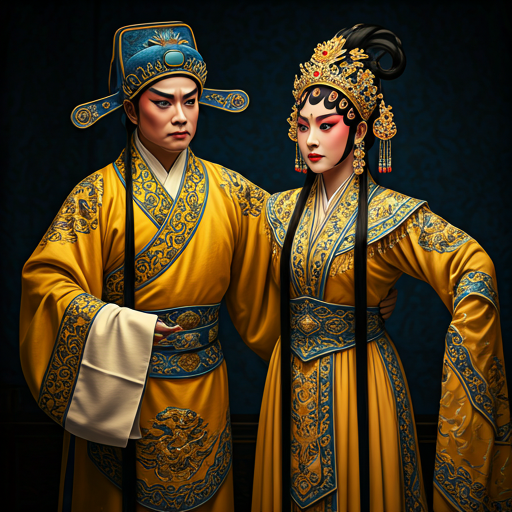
Kunqu reached its artistic peak with Tang Xianzu's masterpiece The Peony Pavilion, written in 1598. The play's themes of love, dreams, and the transcendence of emotion over death perfectly suited Kunqu's expressive capabilities. Tang was born in Jiangxi but settled in Suzhou, absorbing the Jiangnan cultural atmosphere that made his masterpiece possible.
04
From Jiangnan to the World
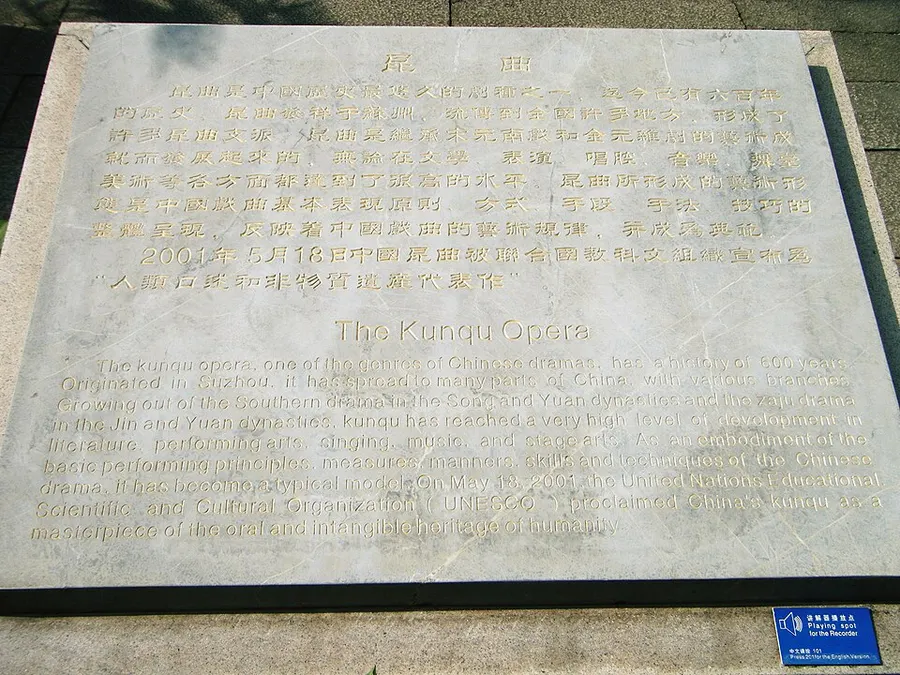
While Kunqu later traveled to Beijing and was adapted into Peking Opera, its soul remains in Jiangnan. UNESCO recognized Kunqu as a Masterpiece of the Oral and Intangible Heritage of Humanity in 2001, and today, the gardens of Suzhou once again resonate with the voices of Kunqu performers.
05
The Water-Polished Voice
The Kunqu sound was engineered in the 1550s by the musician Wei Liangfu, who polished the older Kunshan style until it earned the nickname shuimo, or water-mill texture. A transverse bamboo flute follows the singer note for note while a drum and clapper mark the measure, and a single syllable can unfold across more than a dozen beats through Kunqu opera vocal ornamentation. The result rewards stillness over volume, which suited garden stages where listeners sat steps away from the performer.
06
The School That Outlasted War and Fashion
When commercial Kunqu collapsed in the early twentieth century, forty-plus boys enrolled in a training school established at Suzhou in 1921 under Suzhou opera guild patronage. Every graduate took Chuan as a character in his stage name, and this single class carried several hundred arias, plays, and movement sequences through decades when few theaters would book the form. Their students now head the Shanghai and Nanjing companies, which makes nearly every working Kunqu professional an heir of that one classroom.
07
Scores Kept in Gongche Notation
Kunqu survived three centuries of upheaval largely on handwritten paper. The 1792 Nashuyang qupu that Qing dynasty scholar Ye Tang compiled more than two hundred arias in gongche notation, a mobile-do system whose characters mark the melodic skeleton while leaving ornament to the singer's lineage. That deliberate gap is why two masters can sing the same folio and sound like different arts: the notation records structure, transmission supplies flesh. Libraries in Suzhou, Shanghai, and Beijing hold thousands of hand-copied volumes, many rescued from private trunks after 1950, when the state sent scholars to buy back scripts from retired performers' families. Conservatories still teach singers to read gongche before staff notation, arguing that the older system encodes breath points the modern one ignores. Each recovered folio adds roles to the active repertoire, which is why cataloguing projects continue alongside stage revivals rather than being treated as finished history.