Traditional Crafts
Zhejiang Province, East China
Neolithic period, Yangshao culture (c. 3000 BCE)
Representative List
Master-Apprentice (Hands-on)
Silk Reeling and Weaving
Sericulture and Silk Craftsmanship
"The 5,000-year-old process of cultivating silkworms and weaving silk — a Chinese invention that changed the world through the Silk Road."
CIVILIZATION CONTEXT
CROSS-SITE REFERENCES
This artifact is part of the Intangible Heritage Cluster. It connects to 10 entities across the atlas, spanning 2 regions, 0 masters, 0 festivals, and 1 skill.
Sericulture and Silk Craftsmanship: A Living Heritage
Sericulture — the cultivation of silkworms for silk production — originated in China over 5,000 years ago and remained a closely guarded secret for millennia. The process involves mulberry leaf cultivation, silkworm rearing, cocoon harvesting, silk reeling, dyeing, and weaving. Silk craftsmanship encompasses a vast repertoire of weaving, embroidery, and dyeing techniques that have shaped global fashion and trade.
1
Related Cultural Vectors
Sources & Evidence
Status UNESCO Representative List (inscribed)
Primary source UNESCO Intangible Cultural Heritage, Representative List — Nomination file No. 00197: https://ich.unesco.org/en/RL/sericulture-and-silk-craftsmanship-of-china-00197
- — Inscribed on the UNESCO Representative List in 2009 under the official title "Sericulture and silk craftsmanship of China". (Nomination file 00197; 4.COM 13.22)
- — Its communities of practice are in Zhejiang and Jiangsu Provinces (near Shanghai) and in Sichuan Province (Chengdu). (UNESCO ICH element description, file 00197)
- — The practice spans planting mulberry, raising silkworms, unreeling silk, making thread, and designing and weaving fabric, transmitted within families and through apprenticeship. (UNESCO ICH element description, file 00197)
Last reviewed: 2026-10-13
Status and primary source follow the official record. Other narrative on this page — including cultural interpretation — is the Atlas's own reading, not an external source.
History & Development
Sericulture domesticated an insect into an industry that dressed empires and funded roads. Silkworm rearing and silk reeling are archaeologically attested in the lower Yangtze from neolithic sites, and by Han times the state ran mulberry quotas, silk taxes, and loom censuses; bolts of standardized width served as currency on frontier garrisons. The technology's leak westward, famously via smuggled eggs in the sixth century, seeded Byzantine and Persian weaving, but China kept quality leadership through successive innovations like the Ming-era figured satins.
Today's listing recognises a complete knowledge chain. In 2009 UNESCO inscribed China's sericulture and silk craftsmanship, covering mulberry cultivation, egg care, cocoon cooking, reeling, dyeing, and weaving as one heritage system, with strongholds in the Jiangnan lake districts around Hangzhou. Village cooperatives still time hatching to leaf-out, and our silk stories trace how one cocoon yields nearly a kilometre of filament, the arithmetic behind every metre of cloth.
How It Is Made
- 01
Rearing the worms
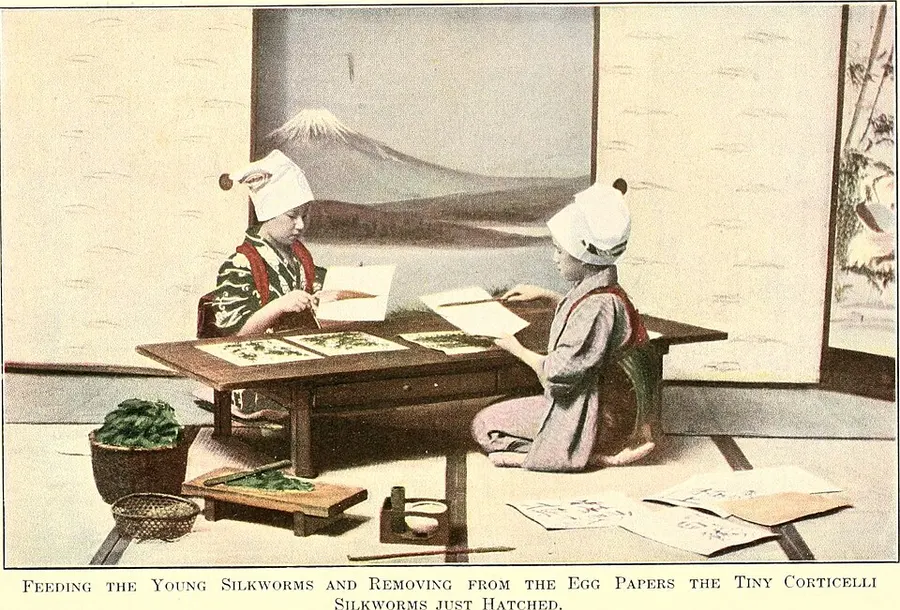
Eggs hatch timed to mulberry flush; trays of larvae are cleaned and fed chopped leaves up to six times daily for a month.
- 02
Spinning the cocoons
Mature larvae spin for about three days, extruding a single filament glued by sericin into a neat oval shell.
- 03
Reeling the filament
Cocoons are softened in hot water and multiple filaments unwound together into raw silk thread, one cocoon yielding up to 1,500 metres.
- 04
Throwing and weaving
Threads are twisted, dyed, and warped into looms; figured satins require drawloom teams, linking this chain to brocade workshops like Nanjing yunjin.
Common Questions
How long is one cocoon's thread?
Between roughly 900 and 1,500 metres, which is why a few thousand cocoons make a single bolt, arithmetic detailed in our silk thread story.
Does harvesting harm the moth?
Reeling requires intact cocoons, so pupae are heat-treated; breeding-line moths emerge only in seed-production stations.
Where is heritage sericulture strongest?
The Zhejiang-Jiangsu lake belt around Hangzhou and Huzhou, where the 2009 UNESCO listing's demonstration villages keep heirloom races and reel silk for conservation looms.
Watch & Learn
Stories & Legends
Silk: The Thread That Connected Civilizations
historicalThe humble silkworm created the world's first global trade network.
Suzhou Embroidery: A Needlepoint Universe
historicalWhere a single silk thread splits into 32 strands to create fabric art.
The Porcelain Road: Jingdezhen and the World
historicalA remote town in Jiangxi produced the finest ceramics the world had ever seen for over a thousand years.
Skills & Techniques
Silk Reeling and Weaving expand_more
The traditional process of cultivating silkworms, harvesting cocoons, reeling silk filaments, and weaving them into fabric on hand-operated looms.
Steps
- Cultivate mulberry trees and raise silkworms on fresh leaves
- Harvest cocoons and sort by quality
- Boil cocoons to soften sericin and reel silk filaments
- Twist filaments into thread and dye with natural pigments
- Set up a handloom with warp threads
- Weave the weft thread through the warp to create fabric
Tools
reeling frame, dye vat, handloom, shuttle, bobbins, scales
Materials
silkworm cocoons, mulberry leaves, natural dyes (indigo, madder, gardenia)
Related Places
Relationship Constellation
Tracing the invisible threads that connect Sericulture and Silk Craftsmanship to the broader civilization ecosystem.
Continue the Journey
Sericulture and Silk Craftsmanship
Traditional Crafts
Farmers' Dance of the Korean Ethnic Group
Traditional Dance
arrow_forwardGesar Epic Tradition
Quyi
arrow_forwardChinese Timber-framed Architecture
Traditional Crafts
arrow_forward