menu_book The Full Narrative
01
Sacred Origins
Tibetan opera was founded in the 14th century by Thangtong Gyalpo, a Buddhist master and engineer. He used the performances to raise funds for building iron-chain bridges across Tibet's treacherous rivers. The operas were originally performed as religious offerings, intended to purify the mind and accumulate merit.
02
The Language of Masks
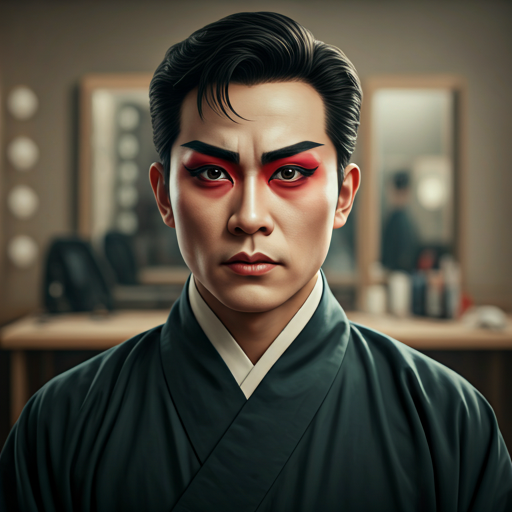
Tibetan opera uses distinctive masks and costumes to convey character, and the palette is fixed: white stands for purity and kindness, yellow for radiance and profound knowledge and is worn by living Buddhas and immortals, blue for justice and bravery and worn by warriors, green for wisdom and grace and used for Tara and Dakinis, red for power and worn by kings and ministers, black for malevolence, and a half-white half-black face for the deceitful trickster. Unlike Peking Opera's painted faces, Tibetan opera masks are actual three-dimensional objects, often adorned with silk and semi-precious stones.
03
Living Tradition at Risk
Tibetan opera was inscribed in 2009 on UNESCO's Representative List of the Intangible Cultural Heritage of Humanity. UNESCO names theatrical stylization alongside rapid economic and social change among the factors threatening it, and master performers in Lhasa and Tibetan communities in exile continue to transmit the art to new generations.
04
The Shoton Season
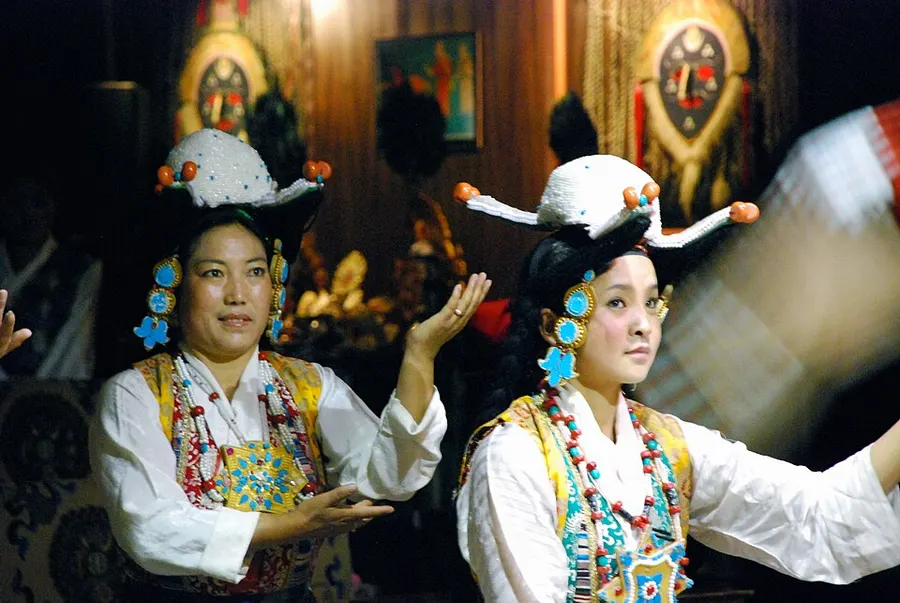
The Shoton Festival anchors the Tibetan opera calendar. Since the seventeenth century, troupes have gathered in Lhasa every summer for the festival's seven days of open-air performance, first beneath the Potala walls and, after 1740, in the gardens of Norbulingka. Four classical blue-mask lineages dominate the historical record. Troupes tracing to Jiumelong, Jonpa, Xiangba and Jianggar each preserved distinct repertoires of dance drills, sung arias, and mask conventions, and village companies competed for the honor of opening the season. A single Ache Lhamo play now runs about six hours, from late morning to late afternoon, and devoted audiences follow one troupe across the entire Lhasa summer festival circuit. Every performance moves clockwise around the stage, an orientation that mirrors the circumambulation practiced by pilgrims across the plateau.
05
Drum, Cymbal, and Voice
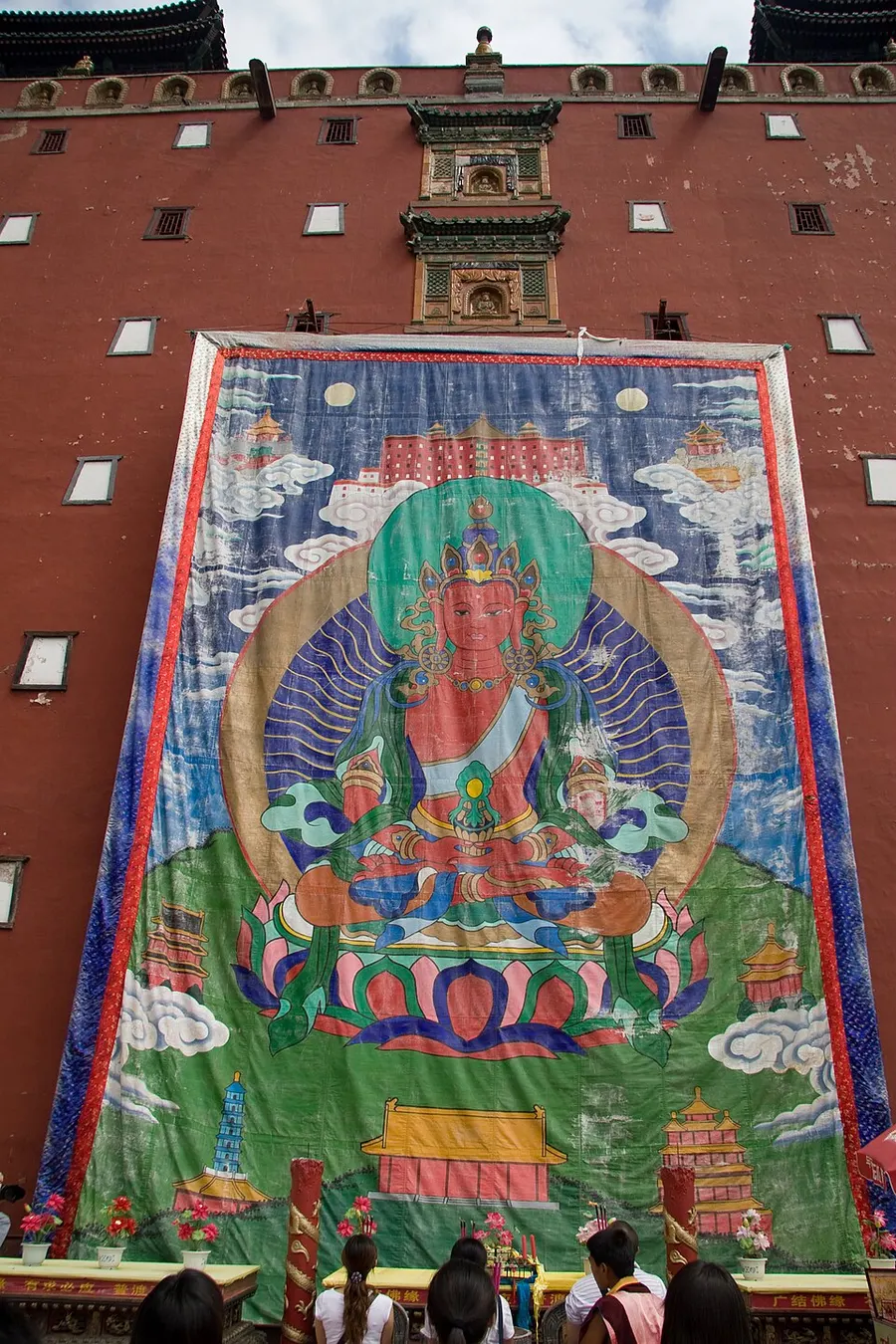
Ache Lhamo requires no orchestra. One drummer and one cymbalist drive the whole performance, stamping out rhythmic cycles that cue entrances, battles, comic interludes, and dances. Singers sustain the piercing, vibrato-heavy vocal register known as zhen, transmitted from childhood through imitation rather than written notation. The repertoire is fixed at eight canonical plays, among them Princess Wencheng and Prince Norzang, and most of them carry Buddhist legend or moral trial as their subject. Masks are carved from light willow wood or pressed papier-mache, then painted in fixed iconographic colors that a plateau audience reads at a glance, much as worshippers read the palette of Thangka painting color symbolism.
06
From Monastery Courtyard to World Stage
State recognition transformed Ache Lhamo after 1959. In 1960 the Tibet Autonomous Region formally founded its Tibetan Opera Troupe on the basis of the old Jiumelong company, moving selected plays from the open-air square onto a proscenium stage with lighting, scenery and painted makeup, while village troupes kept the open-air tradition intact. Protection is financed at regional level rather than by UNESCO: since 2009 every registered folk troupe has received an annual subsidy, and central and regional governments have invested tens of millions of yuan in training bases, facilities and young inheritors. A 2021 census counted 154 performing troupes across Tibet, 21 of them folk troupes in Lhasa, alongside 144 training centres. The art survives because its two settings survive together, the formal stage and the garden lawn.